
Modern software products rarely fail because of a poor choice of database or framework.
They fail because business logic becomes tightly coupled to infrastructure, making change increasingly expensive over time.
When we started building RankTrix, our goal wasn’t simply to create another SEO tool. We wanted to build a platform capable of evolving continuously—adding new analysis engines, machine learning capabilities, storage technologies, APIs, and integrations without repeatedly rewriting the core system.
That requirement led us to choose Hexagonal Architecture, also known as Ports and Adapters.
The Problem We Wanted to Avoid
Many applications begin with a straightforward structure:
- API Layer
- Business Logic
- Database
At first, this works well.
But as the product grows, business rules start depending directly on:
- Databases
- External APIs
- Caching systems
- AI services
- Message queues
- Search engines
Over time, the application becomes increasingly difficult to test, modify, and maintain.
A seemingly simple infrastructure change can ripple throughout the entire codebase.
We wanted to avoid that from day one.
Business Logic Should Outlive Technology
Frameworks change.
Databases change.
Cloud providers change.
AI models change.
Your business rules should not.
At RankTrix, the core SEO engine contains the knowledge that matters:
- SEO analysis rules
- Content quality evaluation
- Content intelligence workflows
- Recommendation generation
- Analysis orchestration
This logic represents the heart of the platform.
Whether we use PostgreSQL today or another datastore tomorrow should not affect how SEO analysis works.
Hexagonal Architecture allows us to keep those concerns separate.
What Is Hexagonal Architecture?
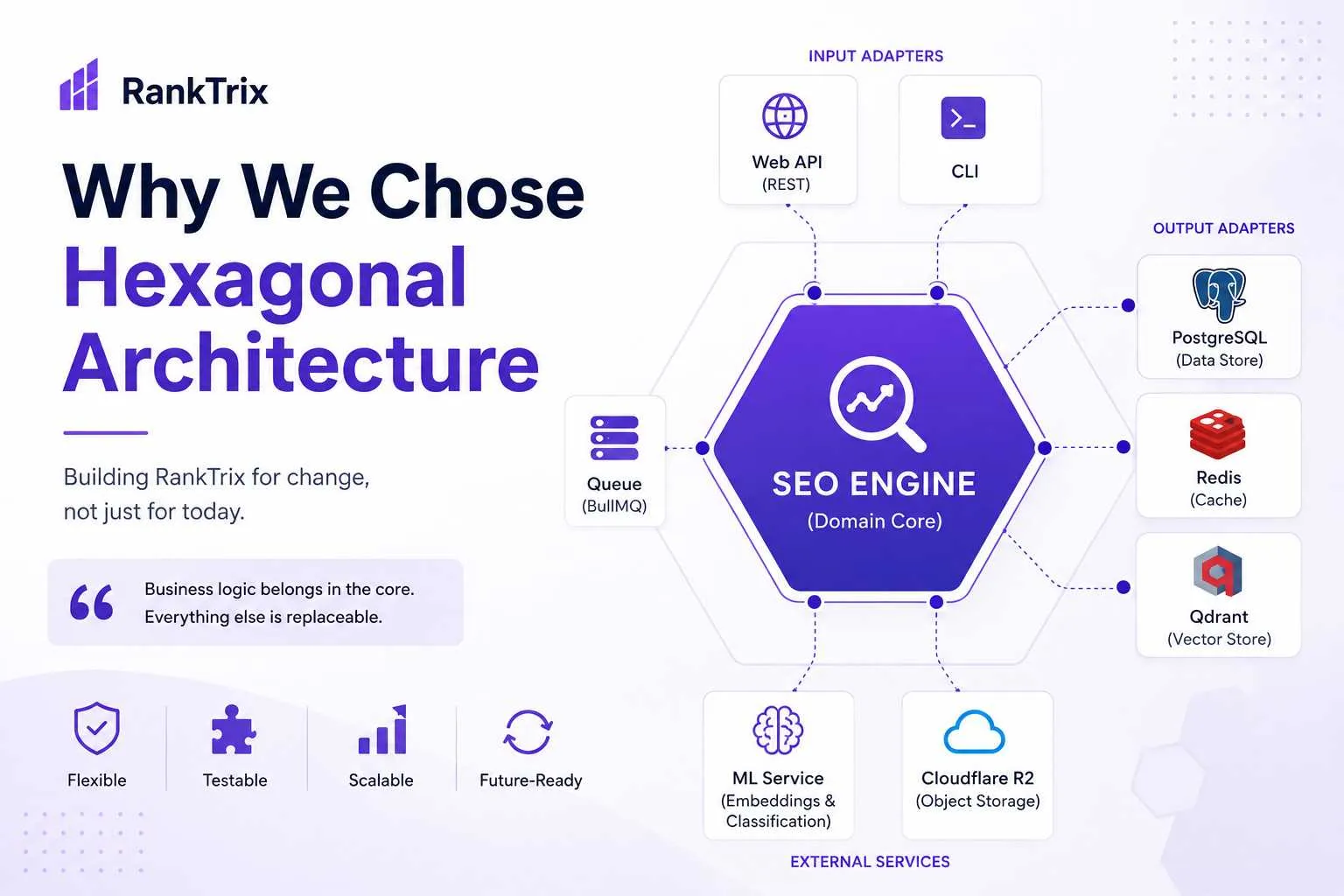
Hexagonal Architecture places the domain at the center and treats everything else as replaceable.
The domain communicates through ports (interfaces).
Infrastructure components implement those ports through adapters.
Instead of the domain depending directly on technology:
Domain → Database
Domain → AI Service
Domain → Cache
The relationship becomes:
Domain → Port
Adapter → Port
The domain knows only what it needs—not how it is implemented.
This creates a clean separation between business logic and infrastructure concerns.
How RankTrix Applies Hexagonal Architecture
At the center of RankTrix sits the SEO Engine.
The SEO Engine understands:
- SEO rules
- Policies
- Analysis workflows
- Content evaluation logic
- Recommendations
It does not know about:
- PostgreSQL
- Redis
- Vector databases
- Object storage
- Web frameworks
- Machine learning implementations
Instead, it communicates through clearly defined ports.
Examples include:
- EmbeddingPort
- ClassificationPort
- VectorStorePort
- StoragePort
Infrastructure adapters implement these contracts.
This allows us to evolve the platform without forcing changes into the business logic that powers SEO analysis.
Why This Matters for RankTrix
RankTrix relies on multiple technologies working together:
- Relational storage
- Caching systems
- Vector search
- Machine learning services
- Object storage
- APIs
- Background processing
These technologies solve infrastructure problems.
They are not the business.
The business is helping users create better content through intelligent analysis.
If tomorrow we replace a cache layer, migrate storage providers, or introduce a new machine learning model, the SEO Engine should continue working exactly as before.
Hexagonal Architecture makes that possible.
A Practical Example
Consider embeddings.
Today we may use one embedding model.
Tomorrow we may choose a different provider, a more advanced model, or even an internally trained solution.
The SEO Engine shouldn’t care.
It simply requests embeddings through an EmbeddingPort.
The adapter decides how that request is fulfilled.
As a result, infrastructure can evolve independently while the business logic remains stable.
That flexibility becomes increasingly valuable as the platform grows.
Testing Becomes Significantly Easier
One of the biggest benefits of Hexagonal Architecture is testability.
Because the domain depends on abstractions rather than concrete implementations, we can test business logic without:
- Running databases
- Starting cache services
- Calling AI services
- Connecting to external systems
Instead, we provide lightweight mock adapters.
This enables:
- Faster test execution
- Better reliability
- Higher confidence during refactoring
- More focused unit testing
The result is a codebase that remains maintainable as complexity grows.
Supporting Future AI and SEO Capabilities
RankTrix is designed to evolve.
Today’s architecture must support tomorrow’s ideas.
As the platform grows, we may introduce:
- New classification models
- Additional NLP pipelines
- Alternative vector stores
- New analysis engines
- Additional integrations
Because these capabilities sit behind ports, introducing new implementations becomes far less disruptive.
The architecture encourages experimentation without compromising stability.
Better Team Scalability
As systems grow, architecture becomes a communication tool.
Clear boundaries help developers understand:
- What belongs in the domain
- What belongs in infrastructure
- Where business rules should live
- How components interact
This reduces accidental complexity and makes onboarding significantly easier.
A new engineer should be able to identify the business logic without first understanding every infrastructure dependency.
Architecture Is a Long-Term Investment
Hexagonal Architecture introduces additional structure.
There are more interfaces.
More abstractions.
More deliberate boundaries.
For small projects, that can feel unnecessary.
For a platform intended to grow over many years, however, the investment pays for itself repeatedly.
Every new feature, integration, migration, and refactor becomes easier because the core remains protected.
Final Thoughts
We didn’t choose Hexagonal Architecture because it is trendy.
We chose it because we believe business logic deserves protection from constant technological change.
At RankTrix, our mission is to help businesses create better content through intelligent SEO analysis.
The architecture exists to support that mission—not the other way around.
Every software product accumulates technical debt over time.
Our goal isn’t to eliminate it completely.
Our goal is to ensure that complexity accumulates around replaceable infrastructure choices rather than the business logic that makes RankTrix valuable.
Technology will continue to evolve.
The core ideas behind the product should not.
That’s why Hexagonal Architecture became the foundation of RankTrix.